28th Feb 2014 was the 7th Rare Disease Day. I only found out about it this year so although a lot of work has been done (over 1000 events in 70 countries have been held) there is still work to be done. So this is my first contribution. Go and have a look at what they have to say (but first finish reading my post ;0).
What is a rare disease? I wrote about my definition in a previous postand the people at Rare Disease Day have a more scientific definition but when you get to their common problems bit you’ll see the similarities. Nobody knows much about them.
In addition to the obvious impact of this lack of knowledge there is an underlying problem that we don’t really look at: empathy or rather, the lack of.
Let’s start with my lack of empathy. A few years ago whenever I heard someone talk about their child having a cold or being sick there was a part of me that muttered “oh puh-lease! That’s nothing. You have no idea how lucky you are”.
I couldn’t listen to their stories, I didn’t understand what that was like: to see your child healthy one moment and then suddenly change and become sick. My baby was sick all the time. I couldn’t relate. I had no empathy for them.
It took a little patience on my part (and isolating myself from other people and feeling pretty alone, to be honest) for me to realise that we do have something in common: being a parent of a child who is sick.
Every parent worries. It’s never nice when your kids are sick. I don’t mean just the cleaning up the puke and poop. Seeing your child in pain, with a fever, knowing that you have done all you can and you still can’t take away their pain. These are the really crappy moments.
So, although I don’t know what your life is like when your child is healthy and ok most of the time, I do know what it is like to see my child suffer so I offer you my empathy, parent to parent.
In honour of Rare Disease Day I ask you to offer your empathy to all those people who have a rare disease. You may not know what their disease is or what impact it has on their lives or even how much harder life is for them. But you do know what it is like to get sick or look after a sick child. You can relate, you can empathise.
Let them know that.
p.s. it’s not sympathy we are looking for, just some understanding.
Ok, so after my impression of Homer Simpson’s “angry dad” last week I was able to chill out and get back to the positive psychology approach to getting kids to eat.
This week I practiced No. 8 Agreeing together what the rules are going to be. The heart of this is control. We gave her space and on Monday she asked if we could barbecue. It’s winter in Amsterdam and it was about 10C so of course we said yes. Hubs bought some meat (ok, this is not in line with “rule 1” but we didn’t have meat for a BBQ in the house. It’s winter!). The kids went outside with Hubs to make a fire and cook. We ate inside.
This is what she ate:
Butterfly lamb chop
Chicken drumstick (she got through half a drumstick)
Green beans
Sauces: piri piri, mayo and ketchup. Lots of it. (no photos, I’m not advertising here).
So how is it that last week eating was a problem and on Monday F had a feast?
Was she just being fussy? No.
Bartters is a rare illness and there is limited understanding of what it is actually like to live with it. Over the years I have talked to adults with it or with Gitlemans and I have come to understand a few things.
Your electrolytes go out of whack at any given moment: your potassium levels can drop when you get stressed, when you are active, when you play a lot, when you get hot … basically, when you do anything, your levels can drop. When this happens, you are dehydrated. You feel nauseous and don’t want to eat.
Everything you do uses potassium. It makes your muscles work. When you don’t have enough, your muscles don’t work as well. So sometimes even swallowing is difficult for F. There was a long time (more than 12 months) where she could chew the food but couldn’t swallow it. So you might want to eat but you can’t.
All those meds you take make you feel like crap, so you don’t want to eat.
Everyday there can be a number of reasons why you don’t want to eat or can’t. That’s why after all these years we still rely on medical nutrition (feeding tube people have you tried Peptisorb by Nutricia? It’s great. Here I will advertise. This dramatically improved quality of life for F and for us).
So Monday was a beautiful day. Her enjoyment of the juicy lamb was clear (it’s been months since she ate red meat) and she chatted all the way through about how delicious everything was.
You can’t imagine my joy at hearing her groan “ohh I’m full”.
I’m just going to savour this memory and stop right here.
The cause is related to her illness and it is reinforced by physical and psychological side effects of this chronic illness.
Not just a fussy eater but literally for years F hasn’t been able to consume more than about 20 kcal a day through eating or drinking, with sometimes months going by without food passing her lips.
This is changing, firstly with Haptotherapy and and now we have a program to encourage her eating which is based on creating opportunities and rewarding her with recognition when she eats. We do nothing when she doesn’t eat, except to say “ok, maybe next time”.
However, this last week I’ve been getting pissed off. Really pissed off. I make things I know she likes and she says “no”. I ask what she wants and she replies “I don’t know”. Sounds like a lot of kids, I know, but I lost it.
I got annoyed and told her I had had enough. We had words. We sat apart, brooding.
She saw my tears and she hugged me. Yes it should have been me that moved first but sometimes our children are just better people than we are.
There’s a fine line between giving space to let them feel free and encouraged to eat and being totally I ineffective letting them just mess about. Sometimes I get lost and don’t know where I am in relation to that line. That’s what this last week was about.
When I’m on the right side of the line, it’s great. Positive psychology to encourage her to eat really does work; her range has expanded greatly and quicker than we ever expected (hey, in our world, getting her to put a whole teaspoon of food in her mouth in one go after 6 years is speedy gonzales fast). And it’s without arguments over food (well apart from the one I mentioned earlier but that was my fault). There is no power struggle. Repeat, no power struggle.
This is what it looks like:
1. We are open to her needs without being slaves to them. For example, we try to have stuff she actually eats in the house. If we have run out we put it on the list for the next time we go shopping. Running out is not the end of the world for either of us.
2. Get her involved in cooking. She loves to chop stuff and sometimes she just uses her hands (mushrooms are super easy at any age). I try to keep something for her to cut and if I can’t do that, then she can put what I have cut up in a bowl before we transfer it to the pan. It is not really necessary but it gives her something to do (and I look like one of those TV chefs from the 80’s who has stuff ready in little dishes. The irony or my scornful question “who cooks like that?”)
3. Let her play with food. There is a reason babies and toddlers shove their hands in their food and smooth it around. They are trying to figure out what it is and what it feels like before they bring it into contact with a very sensitive part of their bodies – their mouths. F totally skipped that activity as a baby (it made her projectile vomit to see a banana let alone touch it) and it only kicked in when she was about 3 or 4 years old. So we let her use her hands, to just touch and explore and to eat. If this is something she needs to do before she can take the next step of taking a nibble, then it’s fine by me. (Restaurant behaviour is a bit different and she is ok with that, she knows why).
4. Patience. Patience. Patience. And a kind voice.
5. Give time for the choice to be made. I start early, especially with dinner as that seems to take the longest. It goes like this:
Me: What do you want for dinner later? we have X, Y, Z (hmm that’s a thought, maybe I should try alphabetti spaghetti. Do they still make that?)
F: I don’t know
Me: ok, think about it or have a look in kitchen. I’m going to start cooking later
As time passes and dinner is getting made, we go through this process a couple more times, with the “deadline” for choice making getting closer.
6. Seems like she can’t make a choice? I just make something, put it on her plate. She will either eat it or not. Quite often she will – isn’t it great when others make the choice for you? I mean, half of my conversations with my husband start with “what shall we have for dinner/lunch?” (hmm another date night is needed methinks).
7. Involve her in the shopping: making the list, picking the stuff up in the shop, pressing ok on the pin machine (she loves this) and putting the shopping away when we get home. Ok, that last one doesn’t happen very much but it’s on my wish list.
8. Agreeing together with her what the rules are going to be. Super duper important one here. My agenda is to get her to eat. Her agenda is to eat, it’s just seasoned with a bit of control, wanting to choose and the occasional urge to just say no.
These all work.
But sometimes I just want to be listened to. Not to discuss but to just say “here, eat this” and be obeyed.
I choose that word deliberately, obeyed. It has nothing to do with eating really and is more about being tired.
Bringing up kids, who can think; make a plan; negotiate; consider the consequences of their actions; be creative, is hard work. It demands the same things of us and sometimes, that leaves me tired and cranky.
So this last week the seed of doubt found it’s way into my mind. It said “she’s just messing with me. Am I stuck in the Princess and the Pea story here?”. So I took the short cut, raised my voice and told her to “just eat!” It would be so much easier to have a robot that would just do what I say! Sigh. Needless to say, it didn’t work.
But a robot would not have given me a hug after seeing my tears. That affection came from the independent human being who can think for herself, who can make her own choices and who was moved to hug me, knowing that it would bring me comfort.
I just want to preface this post with a statement: the majority of the doctors and health professionals I have met are good. My daughter’s team are fantastic and are one of the main reasons I will never move away from Amsterdam (and maybe they don’t know this but they are not allowed to move house or change jobs either!)
This post is about that rare health care professional who leaves an impact, who just blows you away. But not in a good way. So here’s my story.
The first time that I ever felt defeated it was not because of the demands of the illness, it was because I was face to face with the most idiotic doctor that I have ever met.
At 14 months my daughter had her second operation; to place a PEG feeding tube. A hole is cut through the stomach to the outside and tube is inserted and held in place (by the plastic triangle you see in the picture).
The operation went well and a week later they removed the plaster that was placed underneath the white triangle (I only know what it is called in dutch, plaatje). It all looked good, no infection so we went home.
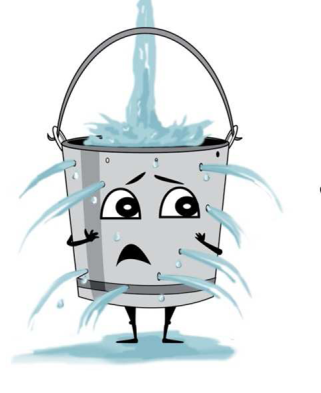
At home I noticed that her clothes kept on getting wet. At first I thought she had spilled something on herself but two clothes-changes later I realised that she was leaking. It was like a magic trick: her clothes were dry, she drank from her bottle and abracadabra, her T-shirt was wet. I did all the checks: triangle in place, not too loose; clamp was closed; no holes. The PEG was ok but she was leaking directly from her stomach! It is bad enough that her kidneys are leaky but now everything she drank just came straight out again in seconds!
How could we stop her dying from dehydration if nothing stayed in? I know that this cartoon and these words don’t really go together but this illustrates what was happening (and I use humour to deal with almost everything).
I took her to hospital and she was admitted. It was the weekend so we had to wait hours for the gastro specialist to come. (A piece of advice – if you are going to get sick and go to the hospital, don’t do it at the weekend. It’s like a ghost town).
Finally the gastro doctor came to see what this obviously crazy mother (me) was getting her knickers in a twist about.
I explained. She looked at me like I was a moron and told me “they always leak a little bit in the beginning. It’s normal. The hole needs to close a bit and that takes a week or so”.
She wouldn’t listen to me; that is was a flood, not a drip.
She didn’t listen to my explanation about Bartters; that my daughters condition means life threatening dehydration and she can’t afford to “leak” for a week or so.
She patronised me some more and I cried.
She walked away.
I had no words. I had been dismissed as if I was a panicky, neurotic mother who jumped at her own shadow.
We had survived 14 months of various calamities such as septicemia, frighteningly high fevers, gastritis, weeks in intensive care, non stop vomiting and I had stayed positive and pragmatic. Now I felt helpless. I knew that we were going to lose her. Not because of the illness but because of arrogance and stupidity.
I was not going to let this happen!
I called the nurse and asked her to watch. My daughter was sitting up and I gave her a drink. The nurses eyes widened and her eyebrows shot up as my daughters clothes became drenched. She looked at me with apology in her eyes and dashed off.
Investigations were done. It turns out that they had cut the hole too big. We came up with a plan: gauzes, regulate the rate of fluid with the feeding pump, only little sips for my thirsty baby.
It got resolved. It often does. But we need to be more than parents, more than carers. We need to be crusaders, ready to withstand the lashes of disdain and condescension meted out by that special group of arrogant doctors who believe that just because we are parents, we know nothing. It only takes one doctor like that to crush your spirit.
Most of the doctors at our hospital are great (please don’t ever develop your career and move on, stay here for us!) and my daughter was alright in the end.
But I will never forget the day when that doctor almost killed my baby because she was too arrogant to listen and too stupid to see.
So to all you good doctors and nurses out there I want to say thank you for listening. We parents sometimes get in the way, ask a lot of questions, insist that you really do just check that again. It’s our job. Thank you for knowing that part of your job is to let us be heard. We are a major part of the care team.
Happy New Year everyone! A sincere and heartfelt wish for good health to you all.
I did not expect to write a “new years” themed post but life is full of surprises.
It wasn’t a good start to the year. By last Thursday (only the 2nd day of the year) it had already become too much for me.
Normally I don’t like to stay up until midnight on New Year’s Eve. I’m tired most of the time anyway and it just takes me too long to recover these days. Plus, there’s something about having to stay up that I rebel against.
I stayed up this year as we were with family (it was a lovely evening) but by Thursday morning I was still recovering. My daughter woke up around 9am feeling ill. With terrible stomach pains, she was crying and throwing up. As I tried to comfort her my mind ran through all the things it could be:
Stomach bug
Bleeding ulcers
All that Piri Piri sauce she ate yesterday
Bleeding ulcers!
Gastritis …. and bleeding ulcers!!!
I have a bit of a paranoia about bleeding ulcers. You see, she is on a combination of meds that can cause ulcers. She has already had severe gastritis because of her meds (age 6 months) and she is on an NSAID that is only for short term use (read weeks) because it causes ulcers and she has been on it for 6 years. Yikes!
It’s a calculated and managed risk. It saved her life in the early months, kept her out of hospital in the first couple of years and allows her to have a good quality of life now.
However, it is a ticking bomb that may or may not go off. If she gets an ulcer she won’t be able to take this or any other NSAID for the rest of her life. Muscle pain and need Ibuprofen? No can do. Quality of life? Seriously affected.
So while all this is going on in my crazy, tired head, and I am trying to comfort her, my poor little girl is crying and asking for Dad (who was temporarily unavailable).
Brimming with frustration and impatience I just wanted to tell her to “stop it, just be quiet”. (Well, I wanted to shout it actually and there were quite a few exclamations marks in my head too).
I took a breath, explained that her dad would be back in 2 minutes and that I needed to go to the toilet. Then I left the room.
I stayed in the bathroom for a long time, much longer than necessary. I put myself in timeout. Her dad was brilliant with her; kind, patient, loving. Just what she needed. I am so grateful to him because last Thursday I just couldn’t do it.
So these are my 3 important lessons for happiness in 2014
It’s good to share the load.
It’s better to walk away than say something you would regret
Accept that Mummy time is never at a civilised time of the day (like 9am on a Thursday). Kids want their mums at stupid o’clock times like 4am on Friday morning. That’s when they want you to sit with them and hold their hand. So I did.
It’s coming up to Christmas and I am taking 2 weeks off from everything. My next post will be in January so with heartfelt gratitude I thank you for reading my blog and sharing this with me.
Enjoy these last 2 weeks of the year and wishing you good health.
Sickness Scale.
My mother once gave me some advice for when your child is ill. “Sometimes you just need to sit up all night with your children and hold them”.
I have found it to be true. Sometimes your children are so ill that it comforts you both to do this: your child finally sleeps in your warm embrace and as a parent you are soothed by being able to give comfort.
But how long can you keep this up? One day, two? Maybe even a week, if you take turns with your partner. But what if they are sick for weeks, months and you just don’t know how long it will be before they are better? You want to keep on holding them for as long as they need but when chronic illness is involved, your children are really ill, really often. Their need for comfort is high and our desire to provide it is strong.
So you try to keep it up, you get tired and eventually a shift starts to happen. They need to be more sick before you stay up all night. It gets easier to go back to bed.
Your assessment scale for illness adjusts.
In the beginning they need to be on a 7-8 on the sickness scale to warrant an all nighter. With a chronically ill child you will do the same. Sickness level is 7-8? Ok, stay up all night with them. It’s the definition of that 7-8 on the sickness scale that changes, not the number.
If they normally throw up about 4 times a day, you notice when they do it 6 times a day and start to get worried at 8. When they stop playing you know it’s really bad and maybe it’s time to go to the hospital.
(side note: yes, kids can throw up regularly and still carry on playing and having fun. My little champ has been doing it for years. Well you can’t spend your entire childhood not playing! Seriously though, I do not know how she does it.)
Your whole view of the world changes. What’s normal? What’s worth worrying about? What’s serious?
From the outside we can seem callous. “What, your daughter has just been sick and you don’t ask her how she is and give her a hug?”. No, but I do teach her how to keep it out of her hair and off her clothes and shoes. This is normal for her. Do you pick up your toddler every time she stumbles? Or is that just normal?
When people don’t understand, and it is really easy of them to misunderstand, it can isolate you. I don’t blame them. When it comes to illness, there is little common ground between you. With parents who also have a child with a chronic illness or people who themselves are ill, it is different. It’s why we get on so well, even when we live on other sides of the world. We share something that many of those around us don’t even know about. We have a different sickness scale.
So next time you wonder “don’t they care?” or hear me say “she’s doing well”, remember: yes we do care and she is doing well, for her.
Our world is just a little bit different and you need to understand the context: our normal is not the same as your normal. Take time to see us, really see. You will see someone who says they are ok but is in pain. That’s because they are ALWAYS in pain like this. So yes, they are ok, but they are still in pain.
Take time to understand and let us in. We want to connect with you. We want to be understood. We want to be seen.
So my mother is right. Yes, I have just admitted that to the world, will I ever hear the end of it? (actually, I am proud to do so). Sometimes you just need to sit up all night with your children and hold them.



 amber rahim