amber rahim

Chronic illness: the parts we don't talk about


4 Comments

my burn out story

When I burnt out I was traveling at 100 mph being batman; saving my business world from the bad guys and crooks who appeared disguised as project managers and stakeholders; and in my private life, fighting off the evil villain of my daughter’s chronic illness.  I was working harder and harder and doing it with a smile and sometimes a snarl.

Finally, a message came through.  My body finally broke through the wall I had put up in my mind to avoid the truth.  My body is a dirty fighter and hit me hard  with aches and pains and finally, took my mind.  I was tired, cranky and short tempered.  I was forgetful, I couldn’t even remember how to spell forgetful.  I couldn’t sleep.  I was exhausted, worn out.

I had an epiphany. ” I need to stop, take a break before I break”.  I thought I was so smart and that I had realized in time.  Ha! Could I have been more wrong?

So I parked my bat mobile, got ready for a 4 week timeout and …… just stopped.  Everything just shut down.  I could barely function.  I had used up all my reserves and was empty.

It took a long time to start back up again, 1 step forward, 1 step back, a step sideways etc.  I started making progress, recovering, to function.  However I realized that there were some things that I couldn’t do anymore and I feared I was broken.  I felt broken.

You see, I thought that people are like elastic bands; when you stretch them too much, they break and they stay broken.

With my burn out, these are the “elastic bands” that broke:

– multitasking.  It took all my concentration to make a cup of tea.  I couldn’t have a chat with you at the same time.

– being able to take on the intensive 24 hour care of a critically ill baby with just my husband and I to split the shifts over.  (Of course I had been trying to do this perfectly).  A lot more work fell on my husband’s shoulders (sorry dear) because I wasn’t able to do my part.

– Being a superhero. Batman was gone, suit back in the cupboard.  I just didn’t care to fight the bad guys anymore

– Being helpful: saying yes, I’ll fix that / take care of it, you can count on me.  Gone.  I just wanted to tell people to, well, insert your own swear word here.

I really thought I had lost a lot but something strange happened during this mega timeout. I started to see things in a new light.  Those things I mentioned just now?  This is what I like to call them now:

– ” tolerating being overworked”

– ” being taken advantage of”

And

-“not asking for help”

Now that I see these “elastic bands” for what they really are; negative, destructive behaviours.  I am glad they are broken.

Who actually wants to be a superhero, working non stop, taking care of everything? (Never mind having to wear your underpants over your tights).

Who wants to do it all alone?

It was with relief that I realized that people are not like elastic bands, we are organic.  We grow, adapt, learn new things.

New things have taken the place of the things I lost.  These are my new things:

The ability to

– say no.  Or “not now” and fit it into a time when I can do it without adding stress.

– recognize if I am becoming overloaded and getting cranky

take action if that happens and get myself back to feeling good: look after myself

And these two are my favourite:

– letting go

– asking for help

Whatever I am doing, it doesn’t have to be perfect.

I can let someone else do it.  I still think there are a lot of things that I can do better than anyone else – I’m not humble, I admit it!.   But if it means that I can take a break, get other tasks done, just breathe, then it’s worth letting someone else do an average job.  I can live with imperfection if I can just breathe.

So did burn out leave me broken?

Actually, it set me free.  Those restrictive bands have burnt away, leaving me covered in a fertile ash where things can grow. I have grown, improved, become a better me.

I can get more done than ever before because I delegate and share the load.  I accept and ask for help.  I focus on what is important and I’m mindful and do one thing at a time (well, ok, I’m not living a zen life but I do it a lot more!).

I feel happy again, I laugh and I experience joy.  I dream and I expect to make some of those dreams come true.

So people, remember this: we are creative, we are resourceful and we are whole.


18 Comments

If the illness doesn’t get you, an arrogant doctor will (try)

I just want to preface this post with a statement: the majority of the doctors and health professionals I have met are good.  My daughter’s team are fantastic and are one of the main reasons I will never move away from Amsterdam (and maybe they don’t know this but they are not allowed to move house or change jobs either!)

This post is about that rare health care professional who leaves an impact, who just blows you away.  But not in a good way.  So here’s my story.

The first time that I ever felt defeated it was not because of the demands of the illness, it was because I was face to face with the most idiotic doctor that I have ever met.

At 14 months my daughter had her second operation; to place a PEG feeding tube.  A hole is cut through the  stomach to the outside and tube is inserted and held in place (by the plastic triangle you see in the picture).

PEG

The operation went well and a week later they removed the plaster that was placed underneath the white triangle (I only know what it is called in dutch, plaatje).  It all looked good, no infection so we went home.

At home I noticed that her clothes kept on getting wet.  At first I thought she had spilled something on herself but two clothes-changes later I realised that she was leaking.  It was like a magic trick: her clothes were dry, she drank from her bottle and abracadabra, her T-shirt was wet.  I did all the checks: triangle in place, not too loose; clamp was closed; no holes.  The PEG was ok but she was leaking directly from her stomach!  It is bad enough that her kidneys are leaky but now everything she drank just came straight out again in seconds!

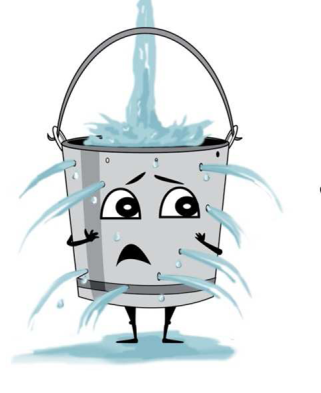
Leaky bucket

How could we stop her dying from dehydration if nothing stayed in?  I know that this cartoon and these words don’t really go together but this illustrates what was happening (and I use humour to deal with almost everything).

I took her to hospital and she was admitted.  It was the weekend so we had to wait hours for the gastro specialist to come.  (A piece of advice – if you are going to get sick and go to the hospital, don’t do it at the weekend.  It’s like a ghost town).

Finally the gastro doctor came to see what this obviously crazy mother (me) was getting her knickers in a twist about.

I explained.  She looked at me like I was a moron and told me “they always leak a little bit in the beginning.  It’s normal.  The hole needs to close a bit and that takes a week or so”.

She wouldn’t listen to me; that is was a flood, not a drip.

She didn’t listen to my explanation about Bartters; that my daughters condition means life threatening dehydration and she can’t afford to “leak” for a week or so.

She patronised me some more and I cried.

She walked away.

I had no words.  I had been dismissed as if I was a panicky, neurotic mother who jumped at her own shadow.

We had survived 14 months of various calamities such as septicemia, frighteningly high fevers, gastritis, weeks in intensive care, non stop vomiting and I had stayed positive and pragmatic.  Now I felt helpless.  I knew that we were going to lose her.  Not because of the illness but because of arrogance and stupidity.

I was not going to let this happen!

I called the nurse and asked her to watch.  My daughter was sitting up and I gave her a drink.  The nurses eyes widened and her eyebrows shot up as my daughters clothes became drenched.  She looked at me with apology in her eyes and dashed off.

Investigations were done.  It turns out that they had cut the hole too big.  We came up with a plan: gauzes, regulate the rate of fluid with the feeding pump, only little sips for my thirsty baby.

It got resolved.  It often does.  But we need to be more than parents, more than carers.  We need to be crusaders, ready to withstand the lashes of disdain and condescension meted out by that special group of arrogant doctors who believe that just because we are parents, we know nothing.  It only takes one doctor like that to crush your spirit.

Most of the doctors at our hospital are great (please don’t ever develop your career and move on, stay here for us!) and my daughter was alright in the end.

But I will never forget the day when that doctor almost killed my baby because she was too arrogant to listen and too stupid to see.

So to all you good doctors and nurses out there I want to say thank you for listening.  We parents sometimes get in the way, ask a lot of questions, insist that you really do just check that again.  It’s our job.  Thank you for knowing that part of your job is to let us be heard.  We are a major part of the care team.


4 Comments

3 important lessons for happiness in 2014

Happy New Year everyone!  A sincere and heartfelt wish for good health to you all.

I did not expect to write a “new years” themed post but life is full of surprises.

It wasn’t a good start to the year.  By last Thursday (only the 2nd day of the year) it had already become too much for me.

Normally I don’t like to stay up until midnight on New Year’s Eve.  I’m tired most of the time anyway and it just takes me too long to recover these days.  Plus, there’s something about having to stay up that I rebel against.

I stayed up this year as we were with family (it was a lovely evening) but by Thursday morning I was still recovering.  My daughter woke up around 9am feeling ill.  With terrible stomach pains, she was crying and throwing up.  As I tried to comfort her my mind ran through all the things it could be:

  • Stomach bug
  • Bleeding ulcers
  • All that Piri Piri sauce she ate yesterday
  • Bleeding ulcers!
  • Gastritis …. and bleeding ulcers!!!

I have a bit of a paranoia about bleeding ulcers.  You see, she is on a combination of meds that can cause ulcers.  She has already had severe gastritis because of her meds (age 6 months) and she is on an NSAID that is only for short term use (read weeks) because it causes ulcers and she has been on it for 6 years.  Yikes!

It’s a calculated and managed risk.  It saved her life in the early months, kept her out of hospital in the first couple of years and allows her to have a good quality of life now.

However, it is a ticking bomb that may or may not go off.  If she gets an ulcer she won’t be able to take this or any other NSAID for the rest of her life.  Muscle pain and need Ibuprofen?  No can do.  Quality of life?  Seriously affected.

So while all this is going on in my crazy, tired head, and I am trying to comfort her, my poor little girl is crying and asking for Dad (who was temporarily unavailable).

Brimming with frustration and impatience I just wanted to tell her to “stop it, just be quiet”.  (Well, I wanted to shout it actually and there were quite a few exclamations marks in my head too).

I took a breath, explained that her dad would be back in 2 minutes and that I needed to go to the toilet.  Then I left the room.

I stayed in the bathroom for a long time, much longer than necessary.  I put myself in timeout.  Her dad was brilliant with her; kind, patient, loving.  Just what she needed. I am so grateful to him because last Thursday I just couldn’t do it.

So these are my 3 important lessons for happiness in 2014

  1. It’s good to share the load.
  2. It’s better to walk away than say something you would regret
  3. Accept that Mummy time is never at a civilised time of the day (like 9am on a Thursday).  Kids want their mums at stupid o’clock times like 4am on Friday morning.  That’s when they want you to sit with them and hold their hand.  So I did.


Leave a comment

What’s different about chronic illness? No.1: Sickness scale

It’s coming up to Christmas and I am taking 2 weeks off from everything.  My next post will be in January so with heartfelt gratitude I thank you for reading my blog and sharing this with me.

I invite you read my first blog https://amberrahim.com/2013/08/28/finding-my-daughter-behind-the-illness/ and with that spirit, enjoy the beauty of those in your life.  See them for who they are and cherish them.

Enjoy these last 2 weeks of the year and wishing you good health.

Sickness Scale.

My mother once gave me some advice for when your child is ill.  “Sometimes you just need to sit up all night with your children and hold them”.

I have found it to be true.  Sometimes your children are so ill that it comforts you both to do this: your child finally sleeps in your warm embrace and as a parent you are soothed by being able to give comfort.

But how long can you keep this up? One day, two?  Maybe even a week, if you take turns with your partner.  But what if they are sick for weeks, months and you just don’t know how long it will be before they are better?  You want to keep on holding them for as long as they need but when chronic illness is involved, your children are really ill, really often.  Their need for comfort is high and our desire to provide it is strong.

So you try to keep it up, you get tired and eventually a shift starts to happen.  They need to be more sick before you stay up all night.  It gets easier to go back to bed.

Your assessment scale for illness adjusts.

In the beginning they need to be on a 7-8 on the sickness scale to warrant an all nighter.  With a chronically ill child you will do the same.  Sickness level is 7-8?  Ok, stay up all night with them.  It’s the definition of that 7-8 on the sickness scale that changes, not the number.

If they normally throw up about 4 times a day, you notice when they do it 6 times a day and start to get worried at 8.  When they stop playing you know it’s really bad and maybe it’s time to go to the hospital.

(side note: yes, kids can throw up regularly and still carry on playing and having fun. My little champ has been doing it for years.  Well you can’t spend your entire childhood not playing!  Seriously though, I do not know how she does it.)

Your whole view of the world changes.  What’s normal?  What’s worth worrying about?  What’s serious?

From the outside we can seem callous.  “What, your daughter has just been sick and you don’t ask her how she is and give her a hug?”.  No, but I do teach her how to keep it out of her hair and off her clothes and shoes.   This is normal for her.  Do you pick up your toddler every time she stumbles? Or is that just normal?

When people don’t understand, and it is really easy of them to misunderstand, it can isolate you.  I don’t blame them.  When it comes to illness, there is little common ground between you.  With parents who also have a child with a chronic illness or people who themselves are ill, it is different.  It’s why we get on so well, even when we live on other sides of the world.  We share something that many of those around us don’t even know about.  We have a different sickness scale.

So next time you wonder “don’t they care?” or hear me say “she’s doing well”, remember: yes we do care and she is doing well, for her.

Our world is just a little bit different and you need to understand the context: our normal is not the same as your normal.  Take time to see us, really see.  You will see someone who says they are ok but is in pain.  That’s because they are ALWAYS in pain like this.  So yes, they are ok, but they are still in pain.

Take time to understand and let us in.  We want to connect with you.  We want to be understood.  We want to be seen.

So my mother is right.   Yes, I have just admitted that to the world, will I ever hear the end of it? (actually, I am proud to do so).  Sometimes you just need to sit up all night with your children and hold them.


15 Comments

You know your illness is rare when…

1.  The doctor gives you medicine, hoping for the side effects.

There are no medicines designed for Bartters or Gitelmans Syndromes (B&G).  Every patient is on a mix of medicines known for certain side effects and we hope that you will “suffer” from them.  For example, diuretics can lead to increased potassium levels so most people have to be careful.  Us B&G folk?  That’s what we are hoping for!  We lose potassium like our kidneys are leaky buckets and we’ve got to plug the holes.

2.  Most specialists haven’t even heard of your condition

Sadly, many people with B&G are being treated by physicians who don’t really know that much about these syndromes.  Often you are the nephrologist’s first patient with this condition.  Yay! You get to be a guinneapig!

3.  You know everyone on the FB or Yahoo support groups by name

There just aren’t that many of you in the world.  Genetics Home Reference estimates it at about 1 per million people. How special is that?

http://ghr.nlm.nih.gov/condition/bartter-syndrome

4.  Prognosis is not known.

There is such limited information that they don’t really know what the future holds.  “If you follow your treatment, you will probably be ok”.  Um, hello?  Remember number 1?

Well, to be fair, who does know what the future holds for them?

Bartters Syndrome, the kidney disorder that my daughter has, is a strange illness and pretty young.  It is named after Dr Frederic Bartter who first described it in 1960.

There are some standard treatments but they don’t really know why they work – just that a lot of the times, they do.

We have had 6 very “interesting” years with the first 3 being a relatively experimental approach to finding a good treatment plan.  For the last 3 years her condition has been stabilising so now finally, at the age of 6, she is doing pretty well.

Now we are at the tough choice time.  Do we change anything in her treatment plan?

For the last 4 years we have been giving her potassium and sodium supplements on an hourly basis.  That’s right.  We give her medicine every hour, of every day.  (We are not martyrs to her illness, we use a medical pump at night).  It is tiring for us but we have developed an amazing ability to know when an hour has passed, without looking at a clock.  In my science class at school I couldn’t even estimate when one minute had elapsed.  Now I am a time master.

More importantly though, it interrupts her day.  Can you imagine someone coming up to you 12-14 times a day asking you to stand or sit still?  How she stays so patient with it I do not understand.

She is stable now, so we could change to say, medicine every 2 hours.  But I hesitate.

  1. Can I retrain my brain to this new schedule?  I might actually have to think about what I am doing!
  2. More importantly, what if this de-stabilises her?  Is the potential benefit of fewer interruptions to her day (and ours) greater than the potential risk to her health?

I just don’t know.  I think I’m going to enjoy this feeling of control a bit longer and leave things as they are.


1 Comment

Ignorance is bliss: so what happens to the bliss once you “know”?

For a while now I have been contemplating the question

“is it possible to experience pure joy once the ignorance of childhood has gone?”

I’m thinking of the phrase “ignorance is bliss” when I pose this question.  We all lose our ignorance as we get older but there is something about chronic illness that brings a lot of knowledge: knowledge of pain and suffering and icky stuff.  Not so conducive to blissful feelings.

I have a draft on this topic and it starts with this:

“when I look at my daughters and their amazing capacity for joy I see a pleasure that comes easily.  A pleasure in a new discovery like what happens when you blow up a balloon and let it go.  In daring to jump and succeeding, or failing and landing on their butts, giggling.  I see and I wonder how they do it.

How do they surrender to the moment completely so that in that moment they are joy?”

I came across this postcard on Facebook the other day (thank you PowerPlug! (Motivational Quotes) ) and I think the answer lies in the first sentence of this quote:

be happy for no reason

They don’t need a reason.  They are just happy, most of the time.

Don’t get me wrong, it’s not all roses.  The thorns are there too.  The tragedy of denial “don’t eat the snail, take it out of your mouth!!!” is an equally vivid, full blown experience.  It is also a wonder and and awesome sight to behold.  the rage followed quickly by the sorrow.  Then, in a blink of an eye, it is gone.  (Yes 3 exclamation marks are necessary; she wasn’t trying to chew it, she was sucking on it.  Excuse me while I heave again).

As adults we have had many experiences, good and bad.  We tend to tone down the joy and try to mute the sorrow.  We have gained knowledge and developed our consciousness.  We have learnt how to choose what we want to study at school, where we want to live, what haircut and clothes etc and these are all fine.  But are they enough?  Do these choices give us a fulfilling life?  Do they make us happy?  I say no, no they do not.

Instead of the usual choices let’s do something different.  Let’s choose how we feel.

Yes I still need to figure out what happens to bliss once you get “knowledge” but today I am choosing to be happy.  For no reason.